Alexamenos Graffito
On Wednesdays, we’ve been walking through the big turning points of the Bible’s story, and recently we reached the climax: the cross.
In this series, we’ve been showing artwork that matches the stories we’re studying—paintings of Abraham, Moses, David, and others. For the cross, though, I chose something very different. Not a beautiful painting, but a crude scratch in stone. I chose it because it reminds us of something we easily forget.
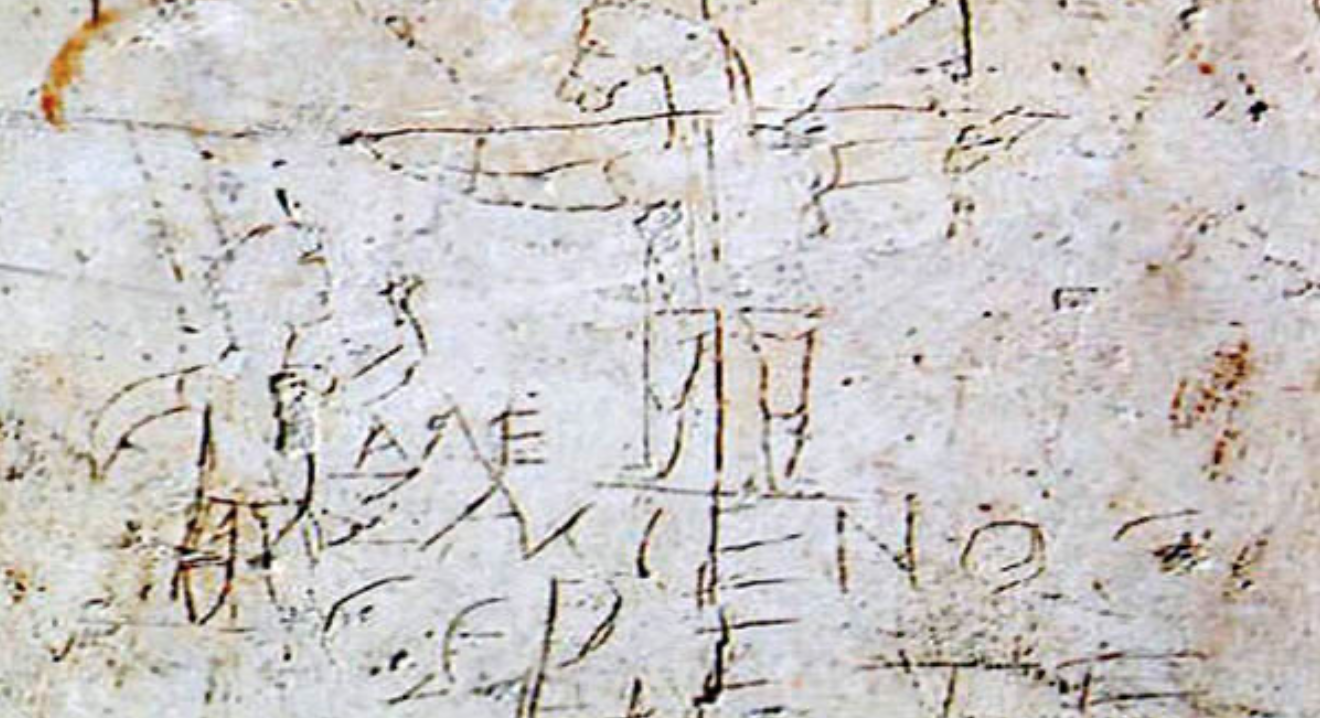
It’s a fragment of history called the Alexamenos Graffito.
It’s literally graffiti—scratched into a plaster or stone surface in ancient Rome. It’s the earliest known depiction of Jesus on the cross that we’ve found so far, dated somewhere between the 1st and 3rd centuries. It was discovered in the remains of the Roman palace complex. Some scholars think it comes from a part of the complex that functioned almost like a boarding school, where boys were trained to serve in the imperial household. If that’s right, this image was probably carved by a boy or young man, and it was aimed at another boy or young man.
And it’s hard to look at.
On the one hand, it’s historical evidence that the earliest Christians really did worship Jesus as their crucified King. It acknowledges that there were people like Alexamenos who lifted their hands in worship to a crucified Christ. But at the very same time, it’s a piece of ridicule, mockery, and blasphemy.
The “artist” drew a man on a cross—but with the head of a donkey. Next to the cross stands another figure, hand raised, as if in worship or prayer. Underneath is an inscription: “Alexamenos worships his god.” It’s meant to sneer at Alexamenos and his Jesus: “Look at this fool, worshiping a crucified god.”
Think about that. The first surviving “art” we have of Jesus on the cross is not a reverent icon or a stained glass window. It’s a cartoon. A joke. A taunt on a wall.
Why? Because while worshiping a crucified God is our joy, our gladness, & our everything, that idea sounded utterly strange to people in the first century.
Rome believed in many gods, not one. Their gods were proud and distant, not humble and near. Romans imagined themselves dying for their gods in battle or sacrifice—not a God who would die for them. They honored their gods because of their power, not because of their love. In their minds, it didn’t really matter whether the gods loved you; what mattered was whether they protected you when you did the right rituals and paid the right honors.
They thought of gods as far above and far away—not as Someone you would know personally, much less have personal relationship with.
So as Christianity spread and the good news centered on this message—“Jesus died for our sins”—many people laughed. They scorned it then, just as many still do now. And yet, at the very same time, there were many then—and there are many now—who hear that same message and cherish it. The same cross that provokes mockery in some hearts awakens worship in others.
Where are you?
When we read the accounts of the crucifixion, some people see only a story of demise—a criminal being discarded, another failed Messiah crushed by Rome. But to us, by God’s grace, it’s a story of shocking mercy: criminals like us being loved, forgiven, and welcomed. Some look at the cross and see weakness, powerlessness, defeat. We read about the cross and see the power of God.
The apostle Paul put it this way in 1 Corinthians 1:18:
“For the message of the cross is foolishness to those who are perishing, but to us who are being saved it is the power of God.” To one set of eyes, foolishness. To another, power. Same cross, different hearts.
I share all this because there’s a subtle temptation for us. We have lived with the cross for so long—on necklaces, in church logos, on the walls of our homes—that we can start to see it as obvious, as normal, as expected. We can get used to it. When that happens, we need to repent.
Because for many people, it is not obvious. It is not normal. They do not yet understand it. And if we’re honest, we often forget how astonishing it really is.
Let’s remember how amazing the cross is. How countercultural. How unique. How scandalous. Let’s refuse to get used to it. Our God is not just one more deity among many. He is set apart—holy, utterly other. No one else is like Him.
And that’s why, in a strange way, the Alexamenos graffito still preaches to us. Alexamenos, hand raised toward his crucified Lord, has it right. His God IS worthy of worship.
Whoever carved this early depiction of Jesus got it all wrong. This is not what ridiculous looks like. This is what redemption looks like.